
Dr. Benjamin H. Krasne, M.D.
Board-certified physicianBoard-certified in anesthesiology, he reads medications and metabolism with a pharmacologist's eye, which shapes how he doses weight loss and longevity care.

Weight loss
GLP-1 shots, daily pills and non-GLP-1 options, prescribed after a free visit.
Start here
Brand-name injections
Pills and other options
Tap your state
State rules change what we can offer and how fast. Pick yours.
ESA and PSD letters, semaglutide, tirzepatide and medical card pages for every state we serve.
Popular ESA cities
Mobile IV in California
One weekly dual-action injection
Tirzepatide is a once-weekly injection that acts on two gut-hormone receptors to curb appetite and steady blood sugar. Book a free visit, and a clinician will tell you whether it fits your health history.
Start with your state
Pick your state to see local rules, pricing and booking.
Licensed U.S. cliniciansPrivate and HIPAA secureFree to book
Ready now? Book a free consultation. Free to book. You pay only if you go ahead with treatment.
Tirzepatide acts on both GLP-1 and GIP receptors to curb appetite and steady blood sugar, with just one injection a week.
Your clinician explains brand Zepbound and Mounjaro alongside compounded tirzepatide, which is not FDA-approved, and confirms your total cost before anything is sent.
You start at 2.5 mg and step up no sooner than every four weeks, with injection guidance for your specific pen or vial.
Check-ins let your clinician slow dose increases if side effects flare, and you can message your care team between visits.
Book online for free and choose a phone or video call. No insurance card or referral is required.
A licensed U.S. clinician goes over your weight history, conditions, current medicines and goals, and asks about the warning signs that would make tirzepatide unsafe.
If your clinician decides tirzepatide is right for you, they write the prescription, explain which form you are getting and set your starting dose. If it is not appropriate, they explain why and what else may help.
You begin at the lowest dose for four weeks. Your clinician raises it in small steps only when you are tolerating it well.
Follow-up visits review your progress, side effects and dose. You can message the care team between visits if something feels off.
Zepbound's label covers adults with obesity, generally defined as a BMI of 30 or more. Your clinician uses your height, weight and history to confirm this.
A BMI of 27 or more along with a condition such as high blood pressure, prediabetes, type 2 diabetes, high cholesterol or sleep apnea may also qualify.
If semaglutide or liraglutide gave you limited results or side effects you could not tolerate, your clinician can talk through whether a switch makes sense.
One injection on the same day each week suits people who would rather not take a daily pill or shot.
Tirzepatide is not used if you or a close relative has had medullary thyroid carcinoma or MEN 2, during pregnancy or alongside another GLP-1 medication. Severe gastroparesis also rules it out.
| Feature | Brand (Zepbound or Mounjaro) | Compounded tirzepatide |
|---|---|---|
| Made by | Eli Lilly | Licensed U.S. compounding pharmacy |
| FDA status | FDA-approved | Not FDA-approved |
| Form | Prefilled pens, KwikPens or vials | Usually a vial with syringe |
| Dosing | Once weekly, up to 15 mg | Once weekly, per your clinician's plan |
| Cost | $299/mo plan; brand medication may cost extra | $299/mo plan |
Tirzepatide is a lab-made peptide that copies the action of two hormones your intestine releases after a meal: GLP-1 and GIP. Turning on both receptors tells your brain you have eaten enough, slows the rate at which food leaves your stomach and helps your pancreas release insulin only when blood sugar is rising. For many people, the most noticeable change is quieter hunger between meals.
The same molecule is sold under two FDA-approved brand names. Zepbound is labeled for long-term weight reduction in adults with obesity, or with overweight plus at least one weight-related condition, and for moderate to severe obstructive sleep apnea in adults with obesity. Mounjaro is labeled to improve blood sugar control in type 2 diabetes. Both are given as a shot under the skin once a week.
When you book with us, a clinician reviews your history and decides which form, if any, is right for you. That may be a brand product, or compounded tirzepatide prepared by a licensed U.S. compounding pharmacy. Compounded tirzepatide is not FDA-approved, which means the FDA has not reviewed that specific preparation for safety, effectiveness or quality. Your clinician will explain the trade-offs before you decide.
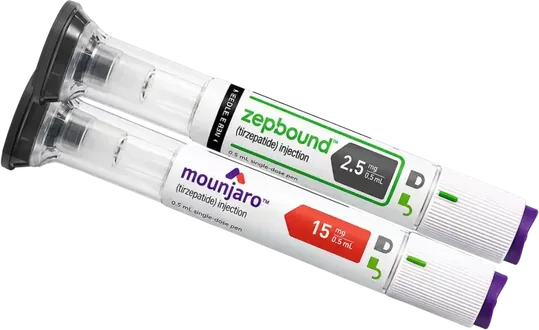
The FDA labels for Zepbound and Mounjaro use the same climb. You start at 2.5 mg once a week for four weeks; this first dose is for getting used to the medicine, not for weight loss. You then move to 5 mg, and after at least four weeks on any dose your clinician may add another 2.5 mg. The ceiling is 15 mg a week.
For weight management, Zepbound's label lists 5 mg, 10 mg and 15 mg as maintenance doses. Many people settle below the top dose if it is working and side effects are manageable. Compounded tirzepatide is dosed by your clinician's plan, and you measure it with a syringe, so read the label on every vial carefully.
Brand Zepbound and Mounjaro are made by Eli Lilly under FDA approval and come as prefilled pens, single-dose vials or newer four-dose KwikPens and multi-dose vials. Compounded tirzepatide is mixed by a licensed U.S. compounding pharmacy for an individual prescription and usually comes in a vial you draw from with a syringe.
The FDA has warned that compounded GLP-1 products are not reviewed by the agency and that dosing mistakes have occurred when people measured doses themselves. If you receive a compounded product, your clinician will walk you through units, syringe markings and the exact volume to draw. Brand medicine may cost more than the plan price; your clinician confirms the total before anything is sent.
In the main FDA-reviewed trial in adults without diabetes, people taking 15 mg lost an average of 20.9% of their body weight at 72 weeks, compared with 3.1% on placebo, alongside diet and activity changes. Individual results vary widely, and your result may be smaller or larger.
Appetite changes often come before scale changes. Most of the weight effect builds over months as the dose rises. Stopping the medicine tends to bring appetite back, so plan the long-term approach with your clinician rather than treating it as a short course.
Most side effects affect the digestive system and are strongest in the days after starting or raising a dose. Your clinician screens for the conditions below before prescribing and can slow your dose increases if needed.
Independently licensed U.S. physicians supervise every treatment we offer.
Board-certified in anesthesiology, he reads medications and metabolism with a pharmacologist's eye, which shapes how he doses weight loss and longevity care.

Trained at Columbia and Washington University, he pairs prescriptions with practical habits around food, training and sleep.

An OB-GYN for more than 40 years and a Fellow of ACOG, she leads women's health care, from perimenopause to PCOS.
See how care, shipping and license checks work where you live. Tap your state to start.
Still deciding? The first consultation is free and takes about 5–10 minutes.
Book a free consultationYes, tirzepatide is the active ingredient in both. Zepbound is the brand approved for weight management and sleep apnea, and Mounjaro is the brand approved for type 2 diabetes. Compounded tirzepatide contains the same active ingredient but is not FDA-approved.
The plan is $299/mo, and booking your first consultation is free. Brand medication can cost extra, so your clinician confirms your total before writing a prescription. You do not need insurance.
Semaglutide acts only on the GLP-1 receptor, while tirzepatide also acts on the GIP receptor. In trials, tirzepatide has generally produced greater average weight loss, but the right choice depends on your history, tolerance and budget.
Many people notice smaller appetite within the first few weeks. Weight change usually builds gradually over months as the dose is raised. Everyone responds differently.
Everyone starts at 2.5 mg. Your clinician increases the dose in 2.5 mg steps no faster than every four weeks, up to 15 mg if needed. Many people stay on a middle dose if it is working well.
Compounded tirzepatide comes from licensed U.S. compounding pharmacies, but it is not FDA-approved, so the FDA has not reviewed its safety or quality. Your clinician will only prescribe it when it is appropriate for you and will teach you how to measure each dose accurately.
Often, yes. Your clinician will look at your current dose, how long you have been on it and how you are feeling, then choose a safe tirzepatide starting dose. Never take two GLP-1 medicines at the same time.
Under the skin of your belly, front of the thigh or upper arm. Use a different spot each week. You can inject at any time of day, with or without food.
If it has been 4 days or less, take it as soon as you remember. If more than 4 days have passed, skip that dose and take the next one on your normal day.
Not always. Your clinician may ask for recent lab results or order tests if your history calls for it, for example if you have diabetes or kidney concerns.
Tirzepatide is not recommended during pregnancy. Tell your clinician if you are pregnant, breastfeeding or planning a pregnancy so they can plan when to stop.
It can make oral contraceptives less reliable. The label advises a backup barrier method, or a non-oral method, for 4 weeks after you start and 4 weeks after each dose increase.
Appetite usually returns and some or all of the weight may come back. Talk with your clinician before stopping so you can plan nutrition, activity and next steps.
Book a free 5–10 minute phone or video visit, no insurance needed. If a licensed clinician decides tirzepatide fits you, plans are $299/mo with ongoing follow-up.
Medically reviewed October 2026. This page is general information and not a substitute for advice from your own clinician. Read our editorial policy.