
Dr. Benjamin H. Krasne, M.D.
Board-certified physicianBoard-certified in anesthesiology, he reads medications and metabolism with a pharmacologist's eye, which shapes how he doses weight loss and longevity care.

Weight loss
GLP-1 shots, daily pills and non-GLP-1 options, prescribed after a free visit.
Start here
Brand-name injections
Pills and other options
Tap your state
State rules change what we can offer and how fast. Pick yours.
ESA and PSD letters, semaglutide, tirzepatide and medical card pages for every state we serve.
Popular ESA cities
Mobile IV in California
Private semen analysis from home
Collect a sample privately at home, have it analyzed by a laboratory and add sperm DNA or hormone testing if you need a fuller picture. A licensed clinician reviews the results with you.
Free to book. You pay only if you go ahead with treatment.
You collect your sample at home with a kit, on your own schedule, and send it to a laboratory for analysis instead of visiting a clinic.
Semen panels measure volume, count, concentration, motility and morphology, compared against WHO reference values, with optional sperm DNA fragmentation testing.
Add a blood-draw hormone panel covering testosterone, FSH, LH, estradiol, prolactin and TSH for a fuller look at what may affect fertility.
A licensed U.S. clinician reviews your results with you by phone or video, explains what the numbers mean and suggests retesting when it makes sense.
On a free 5–10 minute phone or video consult, you'll talk through your goals and history, and the clinician helps you pick the right panel.
Your collection kit ships in discreet packaging with clear instructions, including how long to abstain beforehand.
Collect your sample at home and return it to the lab as directed. If your panel includes hormones, you'll also visit a lab for a blood draw.
A clinician explains each value against WHO reference ranges and outlines next steps, from retesting to treatment or a referral.
If you've been trying for a year, or six months if your partner is 35 or older, testing both partners is a sensible next step.
Testosterone treatment can lower sperm production, so a baseline result helps you plan if future children matter to you.
Some men test before starting a family, after an illness or before treatments that could affect fertility.
A repeat analysis, with DNA fragmentation or hormones added, can clarify what's going on.
Testicular pain, a lump, swelling or a known history of undescended testicles or testicular surgery calls for an in-person exam with a urologist.
| Panel | Semen analysis | DNA fragmentation | Hormone panel |
|---|---|---|---|
| Hormone Panel only, $299 | — | — | Included |
| Semen Analysis, $299 | Included | — | — |
| Semen + DNA Fragmentation, $399 | Included | Included | — |
| Semen + Hormone Panel, $399 | Included | — | Included |
| Complete, $499 | Included | Included | Included |
Fertility is a shared question. The CDC notes that both men and women can contribute to infertility, which for public health purposes is defined as not getting pregnant after a year or more of unprotected sex. Yet testing the male partner is often delayed, even though a semen analysis is simple and non-invasive.
A semen analysis measures how much semen there is, how many sperm it contains, how well they move and what share have a typical shape. Results are compared with reference values published by the World Health Organization. Two optional additions round out the picture: sperm DNA fragmentation, which looks at the genetic material inside sperm, and a hormone panel, which checks the signals that drive sperm production.
No single result settles whether you can father a child. Sperm quality changes from sample to sample, and the CDC points out that a slightly abnormal result doesn't automatically mean a man is infertile. That's why every panel includes a conversation with a clinician about what your numbers mean and whether a repeat test or specialist referral makes sense.
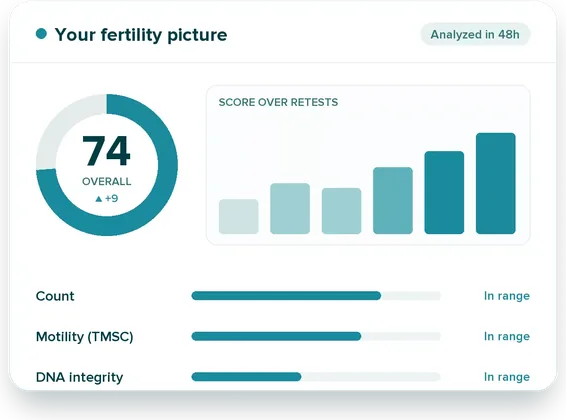
Pick the depth that matches your situation. Your clinician can help you choose.
The WHO laboratory manual (6th edition, 2021) lists lower reference limits drawn from men whose partners conceived within a year. Falling below one of these numbers doesn't mean you can't father a child, and being above them doesn't promise you can; they're reference points, not pass-or-fail lines.
MedlinePlus advises avoiding ejaculation for about 2 to 7 days before collecting, since shorter or longer gaps can skew counts. Follow your kit's specific instructions, collect the whole sample and return it within the time window given.
Because semen quality varies from day to day, a clinician may suggest a second analysis to confirm an unusual result. Sperm take roughly two to three months to develop, so if you change habits or start treatment, retesting is usually spaced out accordingly.
Semen collection carries no medical risk, and the hormone panel uses an ordinary blood draw. The key is interpreting results carefully.
Independently licensed U.S. physicians supervise every treatment we offer.
Board-certified in anesthesiology, he reads medications and metabolism with a pharmacologist's eye, which shapes how he doses weight loss and longevity care.

Trained at Columbia and Washington University, he pairs prescriptions with practical habits around food, training and sleep.

An OB-GYN for more than 40 years and a Fellow of ACOG, she leads women's health care, from perimenopause to PCOS.
Still deciding? The first consultation is free and takes about 5–10 minutes.
Book a free consultationThe core test is a semen analysis, which measures semen volume, sperm count and concentration, motility and morphology. You can add sperm DNA fragmentation and a hormone panel for more detail.
Panels start at $299 for the Hormone Panel only. Semen Analysis is $299, Semen + DNA Fragmentation is $399, Semen + Hormone Panel is $399 and the Complete panel is $499. A clinician review is included with each.
Your sample is collected at home but analyzed in a laboratory against WHO reference values. That's different from home devices that only estimate sperm count.
The WHO lists 16 million sperm per mL and 39 million per ejaculate as lower reference limits. Counts below these don't necessarily mean infertility, and your clinician looks at all values together.
It measures breaks or damage in the DNA carried inside sperm, which a standard semen analysis can't see. It's often considered after unexplained difficulty conceiving, abnormal results or pregnancy loss.
The panel includes testosterone, FSH, LH, estradiol, prolactin and TSH. These hormones help control sperm production and overall reproductive health.
MedlinePlus suggests avoiding ejaculation for about 2 to 7 days before the sample. Your kit will give exact instructions to follow.
Often, yes. Semen quality varies, so a second sample is commonly used to confirm an unusual result. Your clinician will tell you if a repeat is worthwhile.
Timing depends on the panel and how quickly the lab receives your sample. You'll be notified as soon as results are ready, and you can then book your review.
Yes. Taking testosterone can reduce the body's own sperm production. If you're on it or considering it and want children, talk with a clinician about testing and options.
A clinician explains possible causes and next steps. That may mean a repeat test, lifestyle changes, hormone evaluation, treatment if appropriate or a referral to a urologist or fertility specialist.
Kits ship in discreet packaging, and your results are available only to you and your care team. You decide whether to share them with a partner or other doctors.
Usually, yes. Both partners can contribute to difficulty conceiving, so evaluating both gives the clearest picture. Your partner can speak with their own clinician.
Book a free 5–10 minute phone or video visit to choose the right panel. Testing starts from $299, and a licensed clinician reviews every result with you.
Medically reviewed October 2026. This page is general information and not a substitute for advice from your own clinician. Read our editorial policy.